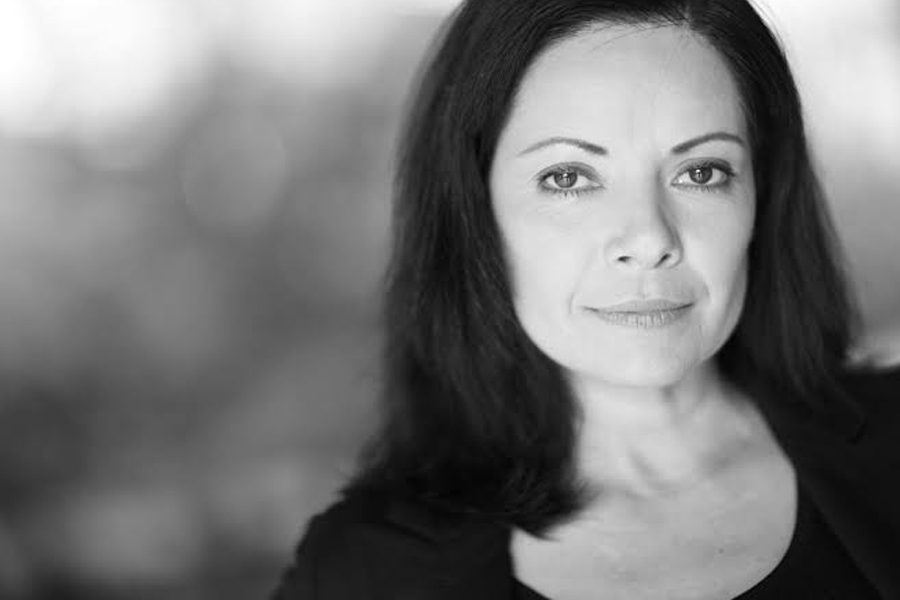
Begona Plaza, also known professionally as Begonya Plaza and Begonya Plaza-Rosenbluth, is a Colombian-born Spanish-American artist whose career has moved fluidly between acting, writing, theater, filmmaking, poetry, singing, and directing. Born on July 12, 1966, in Bogotá, Colombia, she grew up between countries and cultures, carrying Spanish, Basque, Colombian, French, and American influences into her creative life.
Her story is not simply that of an actress who moved from film into theater. It is the story of an artist shaped by movement. Childhood homes changed, languages and customs shifted, and family history stretched from Bogotá to Gernika and eventually to Los Angeles. That experience appears to have given Plaza an unusually broad perspective on identity, belonging, memory, love, and cultural inheritance.
She is approximately 5 feet 4 inches tall, or 1.63 meters, and has maintained a relatively private public profile despite a career that includes film appearances, Off-Broadway theater, independent filmmaking, poetry, and original plays. Her professional work often circles around questions of history and personal transformation, much like a camera returning to the same landscape from different angles.
Begona Plaza Childhood Between Bogotá Gernika and Los Angeles
Plaza was born in Bogotá in 1966, but Colombia was only the first chapter of a highly mobile childhood. Her father came from Gernika, the Basque town in northern Spain that became internationally known after its devastating bombing during the Spanish Civil War in 1937. As a child, her father survived the bombing, an event that later became deeply connected to Plaza’s artistic work.
When Plaza was about two years old, her family moved to Gernika. She spent several formative years there, approximately from ages two to six, surrounded by her father’s Basque homeland and its cultural traditions. The landscape of Euskadi became more than a geographical setting. It became part of her family mythology.
Around the age of six or seven, Plaza moved with her family to Hollywood and Los Angeles. Her father eventually opened a bakery on Hollywood Boulevard near Gower, creating another striking contrast in the family’s story. A child from Bogotá and Gernika was now growing up in Hollywood, surrounded by the entertainment industry that would eventually become her profession.
Her childhood did not remain in one place. Around age nine, she spent time in Bogotá with her maternal family, including a maternal aunt. She also experienced periods in Gernika and France before returning to Los Angeles for high school. She attended John Marshall High School and later studied theater at the Los Angeles Theatre Academy.
These constant geographical changes helped form the multicultural identity that became central to her work. Plaza has described this kind of upbringing as contributing to independence, pragmatism, compassion, and a more universal outlook.
Begona Plaza Family Heritage and Parents
One of the most prominent themes of Plaza’s artistic life is her family history. Born in Gernika, her father was a child who survived the 1937 bombardment. Eventually, Plaza used his recollections of that encounter as inspiration for his documentary.
He opened a bakery on Hollywood Boulevard after the family moved to Los Angeles. Thus, his life linked a number of realms that would eventually recur frequently in Plaza’s own writing: immigration, Los Angeles, Basque history, family memory, and survival.
Plaza’s mother was of Basque and Colombian descent. During Plaza’s early years, this maternal tie kept Bogotá and Colombian family life alive, especially when she resided with relatives there.
Plaza does not consider the family’s history to be just a matter of genealogy. It is an active archive. In her writing, Gernika in particular has emerged as an emotional turning point. Documentary films exploring what occurred to the town and how historical trauma continues to reverberate across generations were motivated by her father’s recollections of the bombing.
Plaza has also stayed in touch with her parents in Gernika and visited them in northern Spain. Her father has continued to play a significant role in her more recent artistic endeavors, such as the “Thank You Dad” piece connected to her later films and projects focused on his memories and sentiments of thanks.
Begona Plaza Daughter Caterina Armenter
One of the most important family relationships in Plaza’s adult life is her daughter, Caterina Armenter. Caterina was born in Barcelona, Spain, in 1992, during Plaza’s years of living in Catalonia.
Caterina represents another branch of Plaza’s multicultural family story. Her background connects Barcelona and the Basque region through her family ancestry, while her own professional and personal life has developed across several countries.
Caterina has worked in film-related positions, including credits connected with the camera and electrical department on projects such as American Hero. She has also been associated with Souvenir Views, a film connected to Plaza’s creative world.
Outside filmmaking, Caterina has pursued a career in digital product design and has worked as a senior UX/UI designer, with professional associations including British Airways and product design and prototyping work. She also maintains interests in photography and travel, documenting experiences across Spain, the United States, Colombia, and other destinations.
Barcelona remains an important family location for Plaza because her daughter lives there. While Plaza’s primary home is associated with New York City, her life continues to move between the United States and Spain through family connections.
Begona Plaza Former Husband Sebastian Xano Armenter
Plaza was previously married to Sebastian “Xano” Armenter, a Catalan painter and artist. Their relationship was connected with Plaza’s period living in Barcelona, where the city became both a personal home and an important influence on her creative development.
The marriage later ended in divorce. That experience has an interesting connection with Plaza’s theater work because her play Teresa’s Ecstasy features a central character returning to Barcelona to confront an estranged husband and deliver divorce papers.
The fictional situation should not be treated as a direct autobiography, but Plaza’s experiences with Barcelona, relationships, art, and cultural differences clearly form part of the atmosphere surrounding the play.
Armenter’s artistic background also connects with Plaza’s creative world. The cover art for the published edition of Teresa’s Ecstasy was by Xano Armenter, making their artistic histories intersect even after their marriage.
Begona Plaza Current Husband and New York Life
Plaza is married to a man referred to publicly as Bobby, and she uses the Rosenbluth surname professionally in the form Begonya Plaza-Rosenbluth.
She maintains her primary residence with her husband in New York City. New York has been a significant part of her professional identity, particularly through theater, playwriting, and independent artistic work.
Her life therefore forms a triangle of sorts. New York represents her current creative base, Barcelona remains connected to her daughter and earlier adult life, and Gernika remains tied to her parents, Basque ancestry, and family memory.
Rather than belonging exclusively to one place, Plaza’s biography suggests a life lived across several cultural coordinates.
Begona Plaza Acting Career in Film and Television
Plaza started performing at an exceptionally young age. She had an appearance in the independent educational film Big Sister when she was about nine years old. In the 1980s and 1990s, her early foray into acting finally led to roles in movies and television.
Throughout her career, she appeared in films with well-known directors and actors. Michael Mann, Oliver Stone, Walter Hill, and Clint Eastwood are some of the directors associated with her work.
In addition to television pilots and other appearances, her chosen credits include 48 Hours, Heartbreak Ridge, Maid to Order, Born on the Fourth of July, Delta Force 2: The Colombian Connection, Heat, Dark Justice, and Tales from the Darkside.
She has also performed on stage and cinema in both Spanish and English, as well as provided voiceovers. Her multilingual upbringing is seen in her ability to switch between languages.
Begona Plaza Theater and Playwriting
Theater eventually became one of the most distinctive parts of Plaza’s artistic identity. She has worked with respected theater figures and was directed by Philip Seymour Hoffman in the original Labyrinth Theatre Company production of In Arabia We’d All Be Kings.
Her theater collaborations have included artists such as Dan Lauria, Barry Gifford, John Randolph, and Kurt Palm. Her stage work has ranged from conventional dramatic roles to more experimental and poetic performances.
Her best-known play is Teresa’s Ecstasy, a full-length two-act drama featuring three characters. It premiered Off-Broadway at the Cherry Lane Theatre in New York in 2012, running from March 4 through April 1.
Plaza originated the role of Carlotta, with Shawn Elliott playing Andrés and Linda Larkin playing Becky. William Pomerantz directed the production.
The play is set primarily in contemporary Barcelona and explores sex, religion, politics, art, feminism, marriage, spirituality, and personal awakening. Its central historical figure is Saint Teresa of Ávila, whose mystical experiences become a catalyst for the modern characters.
Plaza’s interest in Teresa emerged partly while researching Salvador Dalí for another project. A reference to Teresa in a biography of Dalí prompted her to investigate the saint more deeply, eventually leading to the play.
The published edition appeared in 2013 through Broadway Play Publishing. A monologue from the work was also included in The Best Women’s Stage Monologues of 2013.
Begona Plaza Filmmaker and Gernika Storyteller
Plaza’s connection to her father’s birthplace eventually became a major part of her filmmaking.
Her documentary work on Gernika examines the 1937 bombing and its historical and personal consequences. Projects such as The Real Gernika and Gernika Lives combine historical subject matter with family memory, placing her father’s childhood experience within the larger story of the Basque town.
This work gives her filmography a deeply personal dimension. The history is not distant. It happened to her father when he was a child, and his memories became part of the material she carried into adulthood.
Plaza has also created short films and other independent projects, including American Hero, Gero Arte, and The Kiss. Souvenir Views premiered at the Tribeca Film Festival and later reached television audiences through IFC.
Her more recent creative activity includes experimental and documentary-oriented projects such as My Song to the Glaciers and personal work involving her father and family memories.
Begona Plaza Poetry Singing and Spiritual Interests
Plaza’s creative personality goes beyond traditional filmmaking and acting. Her writing has been included in literary anthologies, and she is also a singer and poet.
Her artistic pursuits often revolve around issues of awareness, spirituality, memory, and metamorphosis. Teresa’s Ecstasy and her solo project Quantum’s Big Picture, which examines topics like quantum mechanics, consciousness, near-death experiences, and the connection between scientific concepts and human perception, both demonstrate this.
She also does yoga and meditation. These hobbies go hand in hand with the intellectual and spiritual issues she raises in her writing.
For Plaza, creativity is more like a big chamber with plenty of doorways than a particular career path. Writing comes from acting, history comes from writing, family memories come from history, and cinema comes from family memories.
Begona Plaza and Her Family’s Cultural Geography
The geography of Plaza’s family can be understood through several key places.
| Place | Family or creative connection |
|---|---|
| Bogotá, Colombia | Plaza’s birthplace and her mother’s cultural connection |
| Gernika, Spain | Her father’s birthplace, family home, and inspiration for documentary work |
| Los Angeles, California | Childhood home, high school years, acting beginnings, and her father’s bakery |
| Barcelona, Spain | Adult family life, marriage, creative inspiration, and daughter Caterina |
| New York City | Current primary home and major theater and writing base |
| Ávila, Spain | Important location in Teresa’s Ecstasy and the life of Saint Teresa |
These places form a map of Plaza’s identity. None tells the whole story by itself.
Begona Plaza Financial Status and Public Profile
There is no reliable public information establishing Plaza’s net worth, earnings, assets, or detailed financial circumstances. Her career has been broad rather than centered on commercial celebrity.
She has worked in film and television, theater, independent filmmaking, writing, poetry, and other artistic fields across several decades. Her professional profile includes periods of higher visibility but has remained comparatively private.
Her public presence is primarily artistic. Rather than maintaining a constant mainstream media profile, she has continued to develop independent projects and creative work.
Begona Plaza Family Frequently Asked Questions
When was Begona Plaza born?
Begona Plaza was born on July 12, 1966, in Bogotá, Colombia.
What is Begona Plaza’s background?
Plaza is Colombian-born and Spanish-American, with strong Basque family roots. Her father was from Gernika in the Basque Country, while her mother was Colombian with Basque ancestry.
Who are Begona Plaza’s parents?
Public information about Plaza’s parents is limited. Her father was born in Gernika and survived the 1937 bombing as a child before eventually moving with his family to Los Angeles, where he opened a bakery on Hollywood Boulevard. Her mother was Colombian with Basque ancestry.
Who is Begona Plaza’s daughter?
Her publicly documented daughter is Caterina Armenter, who was born in Barcelona in 1992. Caterina has worked in film-related roles and has also developed a professional career in UX/UI and product design.
Who was Begona Plaza married to?
Plaza was previously married to Sebastian “Xano” Armenter, a Catalan painter and artist. They later divorced.
Who is Begona Plaza’s current husband?
Plaza’s current husband is publicly referred to as Bobby. Plaza-Rosenbluth is the professional name she has used in connection with her married life.
Where does Begona Plaza live?
Her primary residence is associated with New York City, where she lives with her husband. She maintains important family connections with Barcelona and Gernika.
What is Begona Plaza known for?
She is known for acting, playwriting, filmmaking, directing, producing, poetry, singing, and bilingual performance. Her work includes film and television appearances, the Off-Broadway play Teresa’s Ecstasy, and documentary projects about Gernika.
What is Teresa’s Ecstasy about?
Teresa’s Ecstasy is a three-character drama set primarily in Barcelona. It follows Carlotta, a writer returning to Spain, as she confronts her marriage, sexuality, friendship, spirituality, and independence while researching Saint Teresa of Ávila.
When did Teresa’s Ecstasy premiere?
The play premiered Off-Broadway at the Cherry Lane Theatre in New York City in 2012, with performances running from March 4 through April 1.
Why is Gernika important to Begona Plaza?
Gernika is her father’s birthplace and the place where he survived the 1937 bombing as a child. Plaza later explored that family history through documentary filmmaking, making Gernika an important bridge between her personal heritage and her artistic work.
Does Begona Plaza have a connection to Barcelona?
Yes. Plaza lived in Barcelona during part of her adult life, was married to Catalan artist Sebastian “Xano” Armenter, and had her daughter Caterina there in 1992. Barcelona also serves as the principal setting for Teresa’s Ecstasy.
What other creative work has Begona Plaza done?
In addition to acting and playwriting, Plaza has directed and produced short films and documentaries, written poetry, performed as a singer, and developed experimental projects involving spirituality, consciousness, history, and family memory.